Building a 3D printer from scratch is a great school of mechanics, electronics and software. We started by building and modifying printers ourselves, long before Revon printers existed. Here is how to approach such a project.
1. Decide: from scratch or from an open design
The safest start is a proven open-source design (e.g. Voron, RatRig) – you get documentation, a parts list and a community. A fully custom design gives freedom, but you solve every problem yourself.
2. Choose the kinematics
- CoreXY – a light toolhead, high speeds, today the standard in fast printers.
- Bedslinger (Cartesian with the bed on Y) – simple and cheap, but with a large bed the moving mass limits speed.
- Belt printer – for long parts and series production, needs a different approach in the slicer.
3. Frame and mechanics
Frame stiffness decides quality. 2020 aluminium extrusions work for small machines; larger formats need thicker profiles, corner brackets and very stiff beams. Buy linear rails, belts and pulleys from proven suppliers – saving on them shows in the prints.
4. Electronics
- a mainboard supported by Klipper with enough stepper drivers,
- a host (e.g. Raspberry Pi or another single-board computer),
- a power supply with headroom, and for a large bed a 230 V heater switched by an SSR,
- a toolhead – more and more often with a CAN bus board, which simplifies wiring.
Remember safety: thermal protection, frame grounding and correct wire gauges are not a formality.
5. Firmware and calibration
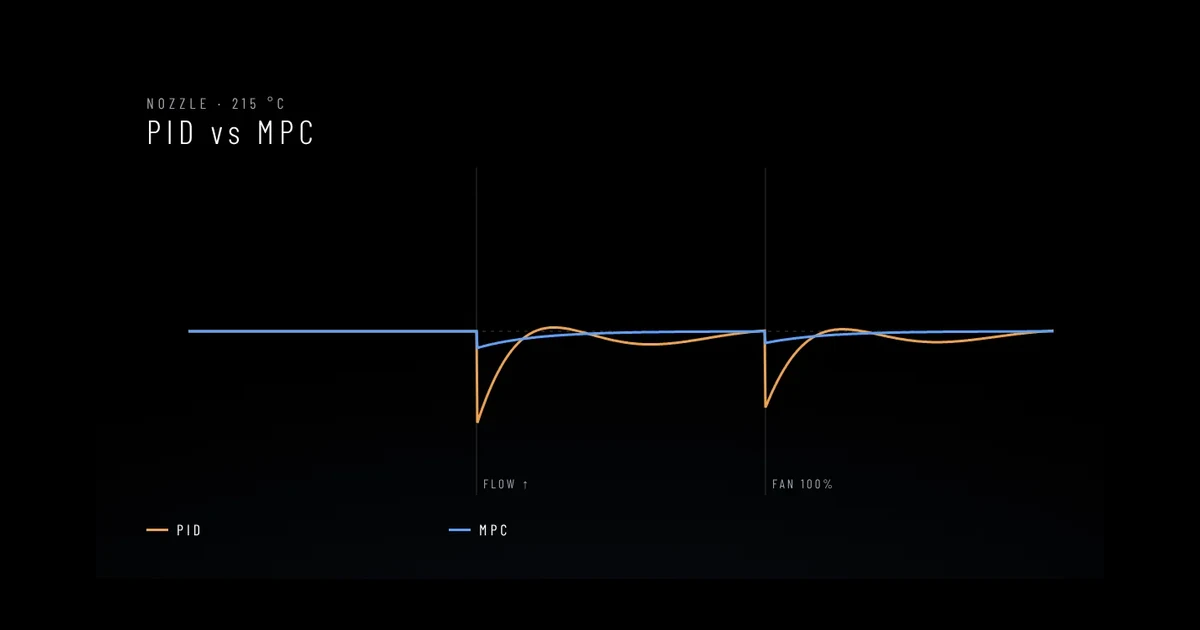
New designs usually go with Klipper (comparison: Klipper vs Marlin). After the first start comes calibration: axis directions and steps, PID, probe and Z offset, bed mesh, input shaping and pressure advance.
Most common pitfalls
- underestimating the time – assembly is only half, the other half is tuning,
- a frame that is too weak for a large format,
- poorly planned cable routing that starts chafing after a few weeks,
- no stock of wear parts.
Build or buy?
If the goal is learning and satisfaction – build. If the printer has to work in a company from day one, a ready machine with service usually costs less than the time spent building and tuning. We also help with self-built machines: Klipper configuration, diagnosis and tuning as part of our 3D printer service.
See also: Voron 600 – build or buy · choosing the build volume · Klipper and Orca Slicer basics