Revon printers now control nozzle temperature with MPC – Model Predictive Control instead of a classic PID controller. You will not see the change on the screen, but you will see it in the print. Here is how the two approaches differ and why we switched.
How PID works
PID looks at a single number: the error – the difference between target and measured temperature. Heater power is the sum of three terms:
- P (proportional) – the larger the error now, the more power,
- I (integral) – accumulates the error over time and removes steady offsets,
- D (derivative) – reacts to how fast the error changes and damps overshoot.
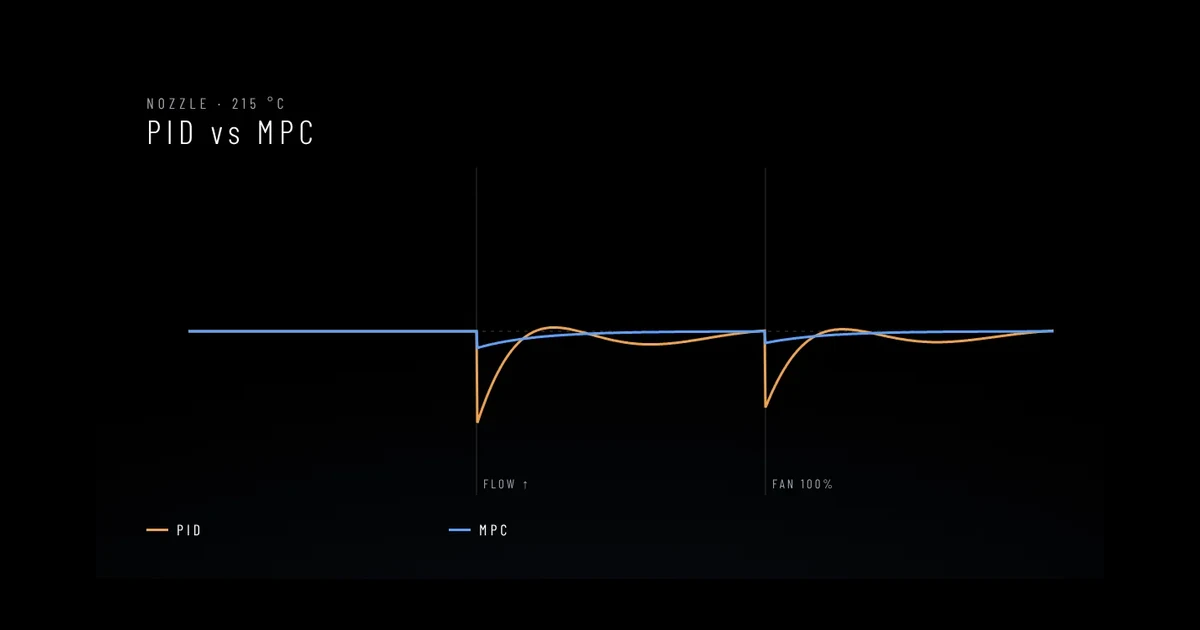
It is simple and robust, but it has a built-in limitation: it always acts after the fact. The temperature has to drift before anything happens. And in a hotend there is a delay between heater, block, nozzle and thermistor – heat needs time to reach the sensor. When the printer suddenly speeds up or switches on the part fan, PID sees the drop only when the plastic is already flowing cooler. Then it catches up, often with some overshoot and oscillation.
PID gains are also tuned at one temperature. At a different temperature, flow rate or fan speed they perform worse.
How MPC works
MPC does not wait for an error. It holds a thermal model of the toolhead – a simplified description of the physics inside the hotend: how much energy heats the block (heat capacity), how fast heat travels from heater to block and sensor, how much is lost to the surroundings and how much the fan takes away.
In short the balance is: heater power = energy to heat the block + losses to ambient + fan losses + heat taken by the filament. Each term can be calculated in advance:
- Filament – the controller knows the current flow (mm³/s) and the material’s specific heat, so it adds power before the temperature drops,
- Fan – it knows the fan speed and its effect on losses,
- Ambient – it takes chamber temperature into account.
From this MPC predicts the temperature a moment ahead for a given power and immediately chooses the power that hits the target. The thermistor reading is then used to correct the model, not to chase the error. This is an approach from industrial automation, used for processes with large delays and predictable disturbances.
Why it matters in 3D printing
- Stable temperature means stable viscosity. Plastic flows more easily the hotter it is. Swings of a few degrees change flow – and with it line width, surface sheen and wall dimensions.
- Fast printing means changing flow. At high speeds flow jumps between walls, infill and short segments. PID cannot keep up; MPC knows about the change immediately.
- The part fan no longer pulls the nozzle temperature down on the next layers.
- Large machines print for hours. Temperature stability means repeatability from the first layer to the last.
How it works in Revon printers
In Revo OS all Revon machines use MPC only – PID is no longer used. The toolhead model comes from a calibration: the printer heats and cools the block itself, measures the response and stores the parameters. We run it at commissioning and after replacing the heater, heater block or thermistor. Replacing just the nozzle (with a 7 mm wrench) does not require a new calibration.
Questions about temperature control in your printer, or want to move to Klipper with MPC? Contact us – it is everyday work in our service.