
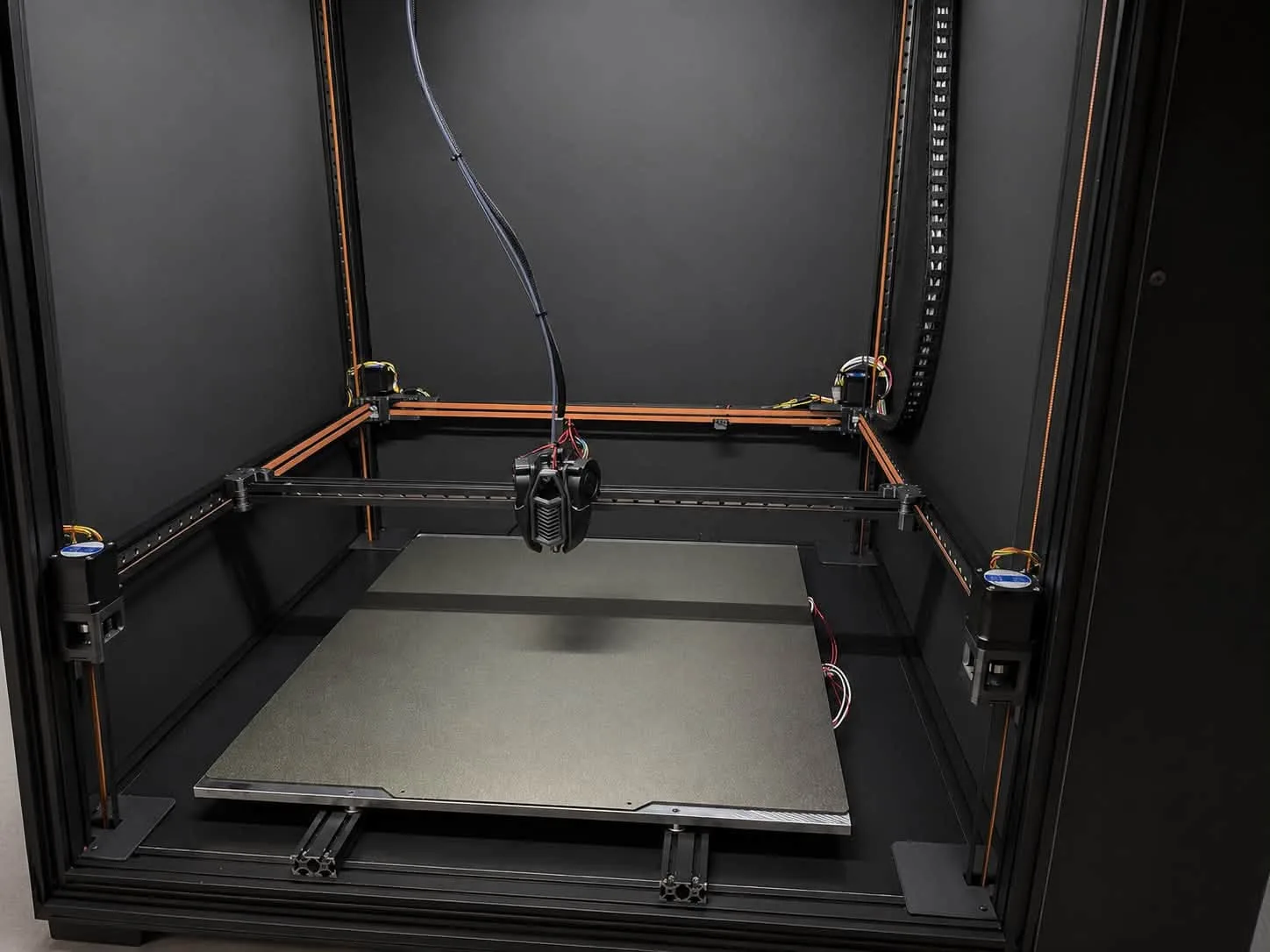
Build volume is one of the first decisions when choosing a 3D printer. Too small – and every larger part has to be split and glued. Too large without need – and you pay for capacity you never use. Here is a practical approach.
Common build volumes
- approx. 250×250 mm – most desktop printers. Enough for small parts, electronics housings, prototypes.
- 300×300 and 350×350 mm – larger CoreXY printers (e.g. Voron 2.4 350). A good compromise for workshops and small companies.
- 500×500 mm – the start of large-format printers. Housings, machine parts, larger models.
- 600×600 mm and more – parts in one piece, moulds, large prototypes, exhibition pieces.
How to work out what you need
- List the largest parts you print or want to print in the coming years.
- Add 10–20% headroom for the brim, supports and angled orientation.
- Decide whether splitting parts is acceptable. Gluing means extra work and a weaker joint.
- Think about batches – a bigger bed lets you print many smaller parts at once.
What changes with a larger build volume
- Print time – large parts take long, so bigger nozzles and a high-flow hotend matter.
- Materials – large ABS, ASA or nylon parts need an enclosed chamber (more: heated chamber 3D printer).
- Design – the bigger the machine, the more frame and gantry stiffness matter; see why scaling a Voron is hard.
- Space and power – a large heated bed usually runs on 230 V and needs a stable stand.
500×500 or 600×600?
We compared this separately in 3D printer 500×500×500 or 600×600.
Revon printers
Revon printers cover large formats: Revon 600 Z400 (600×600×400 mm), Revon 600 (600×600×600 mm), Revon 1200 (1200×600×500 mm) for very long parts and Revon Belt (350×350×300 mm) with a belt for series production.