
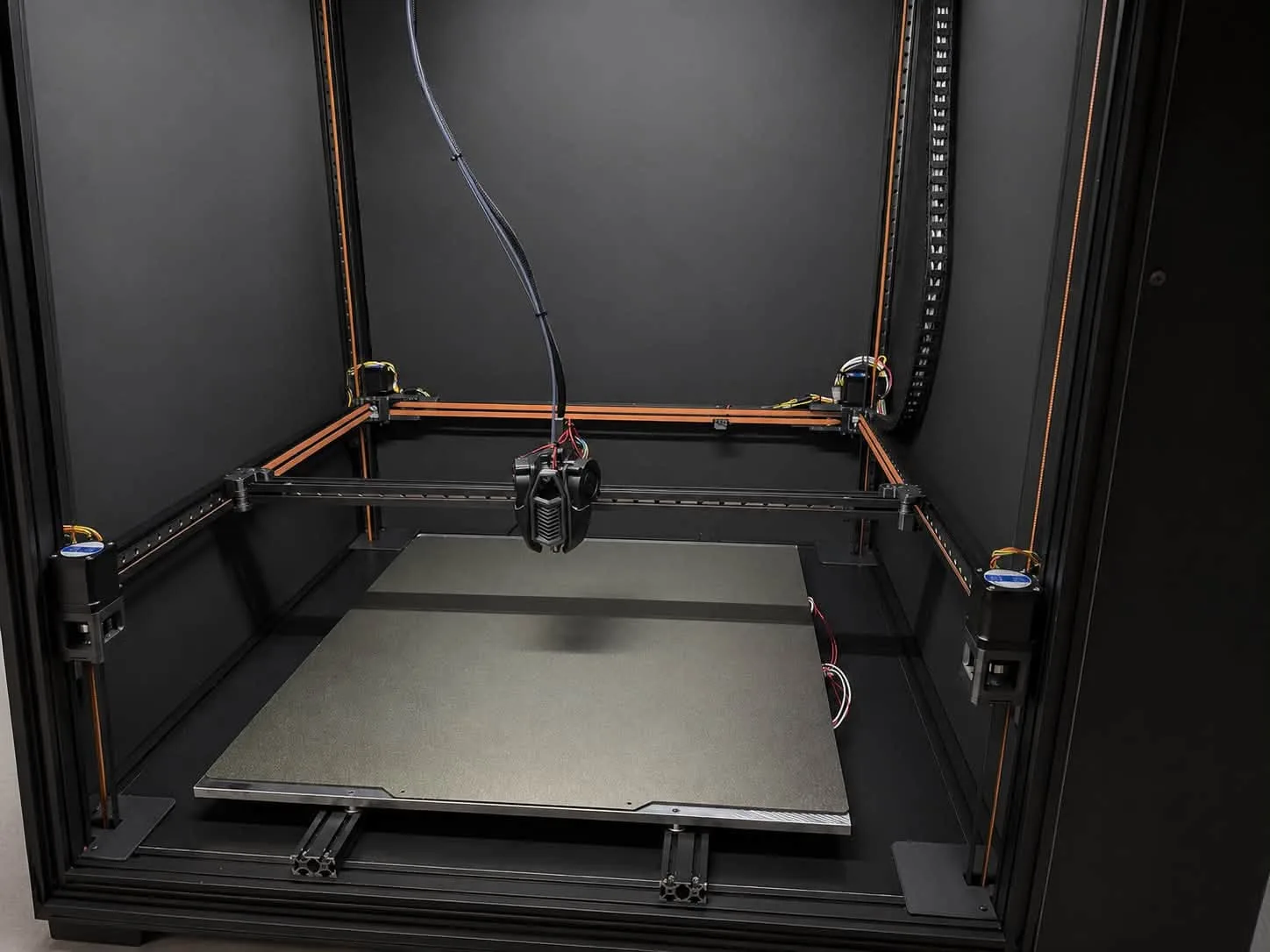
For PLA you don't need a chamber. But with ABS, ASA, nylon (PA) or polycarbonate, or with large prints, an enclosed and heated chamber decides whether a part comes out straight or cracked.
Filament manufacturer's guidance comes first. Every manufacturer has its own formulations and publishes its own parameters – nozzle, bed and chamber temperature, drying, cooling. Even the same material (e.g. PETG) from two brands may need different settings. Treat the values in this guide as a starting point: check the technical data sheet (TDS) and the spool label first, and if something is missing, ask the filament manufacturer for guidance.
Why a 3D printer needs a chamber
Engineering materials shrink strongly as they cool. If the lower layers are cold and the upper ones hot, stresses build up: corners lift off the bed (warping) and tall walls crack between layers. A chamber keeps a stable, elevated temperature around the print and shields it from drafts.
Enclosed vs heated chamber
- Enclosed (passive) – an enclosure warmed only by the bed. Enough for ABS and ASA in smaller prints.
- Heated (active) – a separate heater with a fan and sensor holds the set temperature independently of the bed. Important for large parts, nylons and polycarbonate, where the bed cannot warm the whole volume.
Why the chamber matters more on large printers
The bigger the part, the larger the stresses and the longer the print – and the more chances to crack. With a 600 × 600 mm build area and above, the air volume is so large that without active heating the temperature just above the bed and near the chamber ceiling can differ noticeably.
Which materials need a chamber
- Not needed: PLA, PETG – with PLA a closed chamber can even hurt; print with the door open (see chamber too hot and softening filament).
- Enclosed recommended: ABS, ASA, HIPS.
- Heated recommended: PA and PA-CF/GF, PC, large ABS and ASA parts.
Starting values are in our 3D printing temperature chart.
Things to keep in mind
- Electronics and motors dislike high temperatures – in a good design they sit outside the chamber or are cooled.
- ABS and ASA release odours and particles – an enclosed chamber with filtration is healthier for the room.
- Engineering filament must be dry.
Revon printers
Our Revon printers have an enclosed chamber, and the large formats – Revon 600 and Revon 1200 – are designed for printing engineering materials at large scale. Chamber temperature is shown and set in Revo OS.